

Plywood Thickness for Wardrobe | Which Size Should You Choose?
Other Post

Choosing the right plywood thickness for wardrobe construction has a direct effect on strength, stability, appearance and long-term performance. A wardrobe may look simple from the outside, but different parts of it perform very different jobs. The side panels carry structural load, shelves hold weight, shutters open and close repeatedly, while the back panel mainly keeps the unit aligned.
Because of this, using the same plywood thickness everywhere is not always necessary—or practical.
This guide explains how to choose suitable plywood thicknesses for wardrobe sides, shelves, shutters, drawers and back panels, along with a few important factors to consider before starting your furniture project.
Why Does Plywood Thickness Matter in a Wardrobe?
Wardrobes are used every day and usually remain in place for many years. Their panels need to handle clothes, accessories, drawers, hardware and repeated movement without bending or losing alignment.
Choosing an unsuitable thickness can lead to issues such as:
- Shelves bending under weight
- Shutters losing alignment
- Weak screw holding
- Unstable side panels
- Difficult hardware installation
- Unnecessary increase in furniture weight
- Higher material cost without any practical benefit
The ideal approach is to select the thickness according to the function of each wardrobe component.
Common Plywood Thicknesses Used for Wardrobes
Wardrobe construction may involve several plywood thicknesses rather than a single size.
Typical options include:
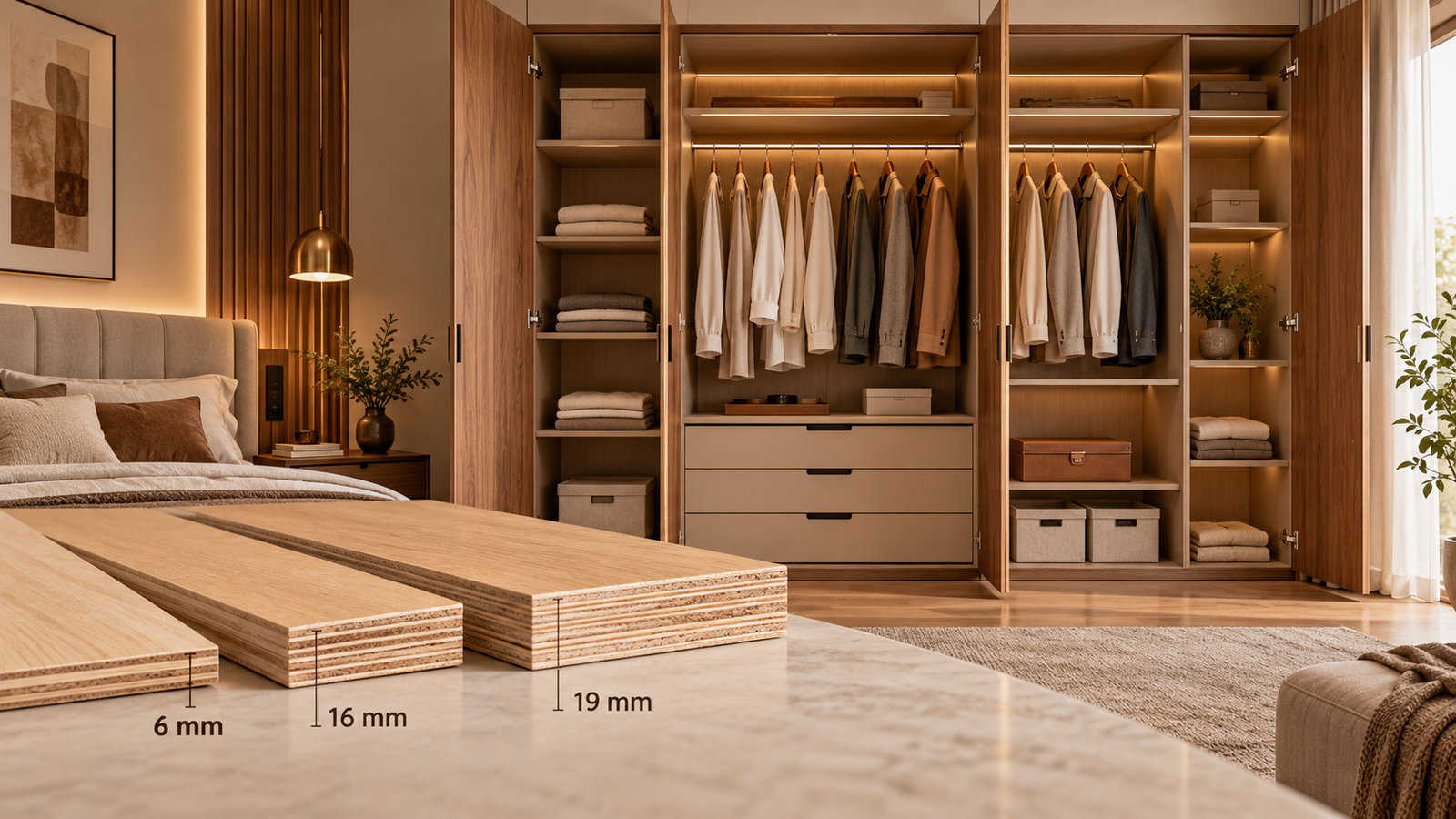
- 6 mm – back panels and lightweight internal applications
- 9 mm – selected drawer or internal components
- 12 mm – lighter shelves and drawer components
- 16 mm – wardrobe bodies, shutters and general furniture panels
- 19 mm – heavy-duty shelves, large shutters and high-load applications
The exact choice should depend on the wardrobe design, span, hardware and expected load.
Is 16mm Plywood Good for Wardrobes?
For many standard wardrobe designs, 16mm plywood provides a practical balance between strength and manageable weight.
It can be considered for:
- Wardrobe side panels
- Top and bottom panels
- Internal vertical partitions
- Standard shelves
- Wardrobe shutters
- Drawer structures
A calibrated 16mm plywood panel can also help achieve consistent dimensions during cutting and installation.
For regular residential wardrobes, 16mm is often sufficient when the design includes proper internal supports and reasonable shelf spans.
When Should You Use 19mm Plywood?
A thicker panel may be preferred where the wardrobe needs to carry more weight or where individual components have larger dimensions.
19mm plywood can be considered for:
- Long shelves
- Large wardrobe shutters
- Heavy storage sections
- Loft storage panels
- Wider unsupported spans
- Frequently used commercial furniture
The added thickness can provide greater rigidity, but that does not automatically mean every wardrobe component needs 19mm material.
Using thicker plywood everywhere can increase both material cost and furniture weight.
Recommended Plywood Thickness for Different Wardrobe Parts
One of the easiest ways to choose wardrobe plywood is to consider each component separately.
1. Wardrobe Side Panels
The side panels form the primary structure of the wardrobe.
Suggested thickness:
16mm to 19mm
For a standard bedroom wardrobe, 16mm can work well. For taller units, heavier construction or designs with larger unsupported sections, 19mm may provide additional rigidity.
2. Wardrobe Shelves
Shelves carry folded clothes, bags, boxes and other belongings.
Suggested thickness:
16mm to 19mm
The correct thickness depends significantly on the shelf width.
A relatively short shelf with proper support may perform well with 16mm plywood. Wider shelves carrying heavier loads may benefit from 19mm panels or additional support.
Important:
Thickness is not the only factor.
A long unsupported shelf can bend even when relatively thick. Good furniture design should control the distance between supports.
3. Wardrobe Shutters
Wardrobe shutters are opened and closed repeatedly and must hold hinges or sliding hardware securely.
Suggested thickness:
16mm to 19mm
For standard hinged shutters, 16mm plywood is commonly practical.
For larger or taller shutters, additional thickness may be considered depending on:
- Shutter dimensions
- Hinge type
- Surface finish
- Handle weight
- Overall design
The carpenter or interior designer should also consider the total shutter weight before selecting hinges.
4. Wardrobe Back Panel
The back panel normally does not carry the same load as the structural sides or shelves.
Suggested thickness:
6mm to 9mm
A well-fixed back panel helps maintain alignment and closes the rear of the wardrobe neatly without adding unnecessary weight.
Using 16mm or 19mm plywood for a standard wardrobe back is usually unnecessary unless the design specifically requires it.
5. Drawer Sides and Internal Components
Drawer construction depends on the size and expected load.
Suggested thickness:
9mm to 16mm
Smaller drawer components can use thinner material, while larger drawers intended to hold heavier items may require stronger panels.
The front fascia may also be thicker than the drawer box itself.
6. Loft Storage
Loft units often store suitcases, blankets, seasonal items and other heavier belongings.
Suggested thickness:
16mm to 19mm
If the loft has wide spans or heavy storage, stronger panels and adequate structural support become more important.
Quick Wardrobe Plywood Thickness Guide
| Wardrobe Component | Suggested Thickness |
|---|---|
| Back Panel | 6–9 mm |
| Drawer Components | 9–16 mm |
| Side Panels | 16–19 mm |
| Vertical Partitions | 16–19 mm |
| Standard Shelves | 16 mm |
| Heavy / Long Shelves | 19 mm |
| Wardrobe Shutters | 16–19 mm |
| Loft Storage Panels | 16–19 mm |
These are practical general guidelines rather than rigid rules. The final specification should account for the wardrobe dimensions, load and construction method.
FAQs
For many standard wardrobe components, 16mm plywood is a practical option. Longer shelves or heavier sections may require 19mm plywood.
Yes, 16mm plywood can be suitable for standard wardrobe bodies, partitions, shelves and shutters when the furniture is properly designed and supported.
19mm plywood provides greater rigidity and can be useful for long shelves, larger shutters and heavier storage sections. It is not necessary for every component.
A 6mm to 9mm panel is commonly adequate for wardrobe backs when properly fixed to the main structure.
MR plywood is generally suitable for wardrobes in normal dry bedroom conditions. For areas with higher moisture exposure, BWP plywood may be considered
Category :
Share :